Recruitment in 2026: Why Job Portals Without AI Will Fail Local Hiring
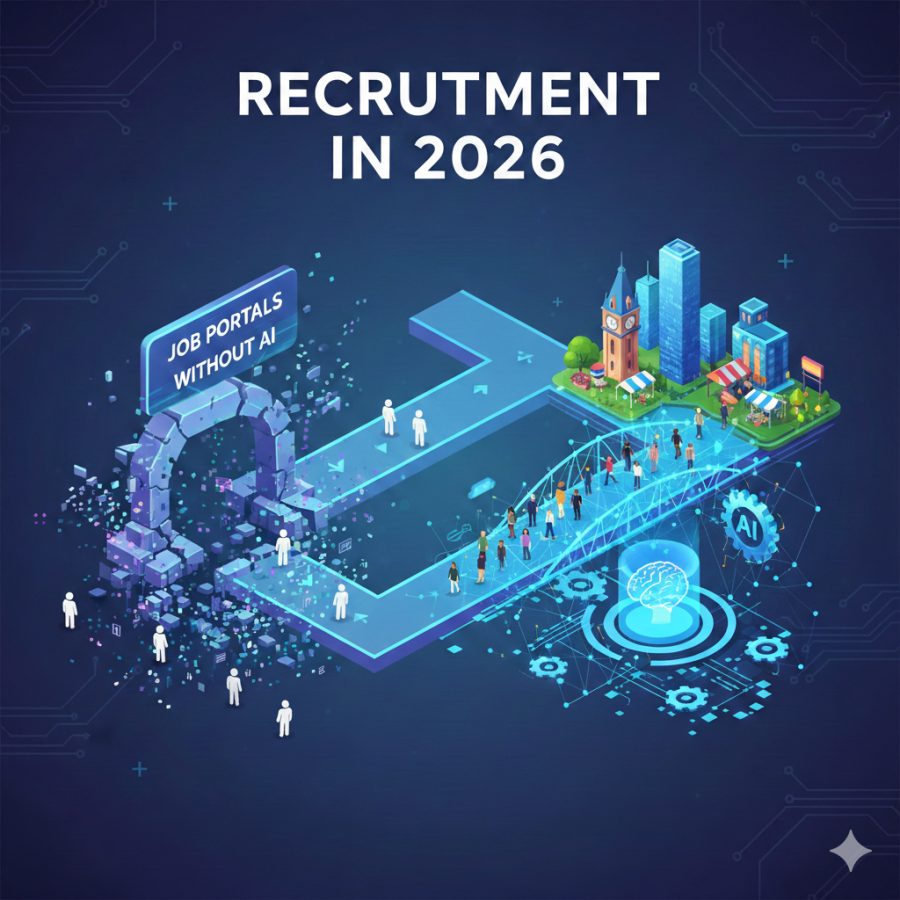
The New Reality of Local Hiring
The year 2026 has brought unprecedented changes to how people find work and how businesses hire in India. Job seekers expect instant results when searching for opportunities, employers need positions filled within days rather than weeks, and the competition for good talent has never been fiercer. In this environment, traditional job portals that rely on basic search functions and manual processes are struggling to keep up.
The stark reality is simple: job portals without artificial intelligence are becoming obsolete, especially for local hiring. When someone searches for "hiring near me" or needs to fill a position quickly in their neighborhood, outdated platforms cannot deliver the speed, accuracy, and convenience that modern users demand. This isn't about following trends—it's about survival in a market where user expectations have fundamentally shifted.
Understanding why AI has become essential for any local job portal requires looking at what's changed in recruitment, what today's users expect, and why traditional methods simply cannot compete anymore.
The Impossible Expectations of Modern Job Seekers
Today's job seekers, whether fresh graduates or experienced professionals, have grown accustomed to instant gratification in almost every aspect of their digital lives. They order food and see it arrive in 30 minutes. They book cabs that show up within minutes. They shop online and track deliveries in real-time. Naturally, they expect similar efficiency when searching for employment.
When someone in Ghaziabad opens a job portal in India and searches for "jobs near me," they're not willing to scroll through hundreds of irrelevant listings. They don't want to see opportunities in distant cities, positions requiring skills they don't have, or jobs offering salaries far below their expectations. They want smart, personalized results immediately.
Without AI, a job portal cannot deliver this experience. Traditional search functions only match exact keywords. They cannot understand context, cannot learn user preferences, and cannot prioritize results based on relevance. A basic search for "hiring near me" might return every job within a 50-kilometer radius, forcing users to manually filter through hundreds of unsuitable options.
This creates frustration and abandonment. Job seekers simply move to platforms that give them what they need faster. For a local hiring platform, losing users to competitors means losing both sides of the marketplace—fewer job seekers mean fewer employers want to post there, creating a downward spiral.
Why Employers Cannot Afford Slow Hiring
On the employer side, the pressure is equally intense. Business moves fast in 2026, and unfilled positions directly impact revenue. A restaurant missing kitchen staff during wedding season loses bookings. A retail store without sales associates during festivals misses its yearly targets. A logistics company short on delivery personnel faces customer complaints and contract penalties.
Traditional job portals make employers wait. After posting a job, they must wait for applications to trickle in over several days. Then they must manually review each application, trying to identify qualified candidates from a pile of resumes. Then they start calling candidates, many of whom don't answer, have already found other jobs, or turn out to be unsuitable despite their resumes looking good.
This process typically takes 15 to 30 days for most positions. In fast-moving markets, this timeline is unacceptable. Competitors using AI-powered platforms are filling the same positions in 5 to 7 days, gaining a significant competitive advantage.
Without AI, a local job portal cannot compress this timeline. There's no way to instantly screen hundreds of applications, no way to automatically match job requirements with candidate profiles, and no way to identify the most promising candidates immediately. Employers who need fast hiring will inevitably abandon platforms that cannot deliver speed.
The AI Advantage in Job Matching
The difference between AI-powered and traditional job portals becomes most obvious in job matching quality. Consider a real example: a manufacturing unit in Noida needs a maintenance technician with electrical knowledge, three years of experience, and the ability to work night shifts. The ideal candidate should live within 15 kilometers to minimize commute issues.
On a traditional platform, the employer posts this job with relevant keywords. The system shows the listing to anyone who searches those keywords. The employer might receive 200 applications—but many will be from electricians without maintenance experience, technicians who live too far away, candidates with only one year of experience, or people unwilling to work night shifts. The employer must manually check each application to find suitable candidates, a process that takes hours or days.
On an AI-powered local hiring platform, the system instantly analyzes all registered candidates, identifying those who match every requirement. Within minutes, the employer sees a ranked list of 15 highly suitable candidates. The AI considers not just skills and experience but location data (showing actual commute distance), shift preferences from candidate profiles, and even patterns from similar successful placements.
This precision transforms hiring outcomes. Instead of spending days screening to find 5 good candidates, employers get those candidates immediately. Instead of interviewing 20 people to make 3 good hires, they interview 8 people and make 3 excellent hires. The time savings and quality improvement are dramatic.
For job seekers, AI matching means they only see jobs they're genuinely qualified for and interested in. Someone searching for "hiring near me" receives personalized recommendations based on their complete profile, not just keyword matches. This saves time and increases the likelihood of finding suitable employment quickly.
Why Location Intelligence Requires AI
Local hiring has unique challenges that AI solves particularly well. Geographic proximity seems simple—just show jobs within X kilometers—but reality is more complex. Two jobs might be the same distance from a candidate's home, but one requires crossing a congested area during rush hour while the other has a direct metro connection. One commute takes 30 minutes, the other takes 90 minutes.
AI-powered platforms in 2026 understand these nuances. They consider actual travel times, not just distances. They factor in available transportation options. They learn that certain candidates are willing to travel farther for specific types of opportunities but prefer closer options for routine positions.
Traditional job portals treat "jobs near me" as a simple radius search. AI treats it as a complex optimization problem, balancing distance, commute time, transportation options, and individual candidate preferences. This intelligence makes local hiring significantly more effective.
For employers, this means candidates who actually show up and stay. Hiring someone who faces a difficult daily commute often leads to quick resignations. AI helps identify candidates for whom the location is genuinely practical, reducing turnover and improving long-term hiring success.
The Speed Imperative for Fast Hiring
In 2026, speed isn't just a nice feature—it's a fundamental requirement. The job market moves so quickly that delays of even a few days can mean losing top candidates to competitors. This is especially true for local jobs where multiple employers might be competing for the same small pool of qualified local talent.
AI enables fast hiring through multiple mechanisms. Automated screening processes applications instantly instead of making employers wait for manual review. Smart notifications alert suitable candidates the moment a relevant job is posted, bringing qualified applicants within hours. Chatbots conduct initial screening conversations, filtering out unqualified candidates before human involvement. Automated scheduling coordinates interviews without the endless phone tag that traditionally delays hiring.
Without these AI capabilities, a job portal in India cannot compete on speed. Employers who need positions filled urgently will simply use platforms that deliver results faster. In competitive hiring situations—say, multiple retail stores preparing for the same festival season—the employer using AI-powered tools will secure the best candidates while competitors using traditional platforms are still sorting through applications.
The Data Advantage
Another critical advantage of AI-powered platforms is their ability to learn and improve. Every successful placement teaches the system something. It learns which candidate characteristics predict success in specific roles. It learns which employers offer better opportunities, leading to lower turnover. It learns which salary ranges attract quality candidates in different areas.
This accumulated intelligence makes the platform progressively better at job matching. A traditional job portal operates the same way on day one and day one thousand. An AI-powered local hiring platform gets smarter with every interaction, providing increasingly accurate matches and better outcomes for everyone.
For a local job portal, this creates a powerful competitive moat. As the platform accumulates more data about local markets, it becomes increasingly difficult for competitors to match its matching accuracy and speed.
Market Signals Point to AI Necessity
The market is already showing clear signals. Job seekers increasingly prefer platforms that provide personalized job recommendations rather than requiring extensive manual searching. Employers report higher satisfaction with platforms that deliver qualified candidates quickly rather than large volumes of unqualified applications.
Platforms that have integrated AI are capturing market share rapidly, while traditional portals are seeing declining user engagement. The pattern is unmistakable: AI adoption isn't optional anymore—it's existential.
What Happens to Traditional Platforms
Job portals that continue operating without AI face a predictable trajectory. As AI-powered competitors offer better experiences, the best employers and most active job seekers migrate to those platforms. This leaves traditional portals with less engaged users, older job postings, and declining relevance.
The network effects that make job portals valuable work in reverse. Fewer active job seekers mean fewer employers want to post there. Fewer job postings mean fewer job seekers visit. The platform enters a decline that's difficult to reverse.
Some traditional platforms attempt to compete on price, offering free or very cheap job posting. But employers increasingly realize that saving money on posting fees while taking three times longer to hire actually costs far more in lost productivity and revenue. They're willing to pay for platforms that deliver fast hiring results.
The Path Forward
For any local hiring platform operating in 2026, the message is clear: integrate AI or become irrelevant. This doesn't mean abandoning human elements—personal service, support, and judgment remain valuable. But the core functions of job matching, screening, and coordination must be AI-assisted to meet modern expectations.
The good news is that AI technology is now accessible. Platforms don't need massive development budgets to implement smart matching algorithms, automated screening, and intelligent recommendations. The technology exists and can be integrated effectively.
The platforms that thrive will be those that embrace AI while maintaining focus on user needs—making local hiring faster, easier, and more successful for everyone involved.
Conclusion
The recruitment landscape has changed fundamentally. Job seekers expect instant, personalized results. Employers demand fast hiring with quality candidates. The geographic complexities of local hiring require intelligent solutions that traditional search cannot provide.
Job portals without AI simply cannot meet these requirements. They'll continue losing users to smarter competitors until they become obsolete. For any platform focused on local hiring, AI isn't a future consideration—it's a present necessity.
The platforms that recognize this reality and act on it will thrive. Those that don't will join the long list of technologies that failed to adapt when the market shifted. In the competitive world of recruitment in 2026, there's no middle ground.
Frequently Asked Questions (FAQs)
Q1: Why can't a job portal in India work well without AI anymore?
Modern job seekers and employers expect speed and accuracy that manual processes cannot deliver. Without AI, job matching takes longer, results are less relevant, and users get frustrated. When someone searches for hiring near me, they expect smart, filtered results immediately—something only AI can provide at scale. Platforms without AI lose users to competitors that offer better, faster experiences.
Q2: How does AI specifically improve local hiring compared to traditional methods?
AI understands complex location factors—actual commute times, transportation options, and individual preferences—rather than just simple distance calculations. A local hiring platform with AI can match candidates to jobs based on practical commute feasibility, not just proximity. This leads to better hires who actually stay in positions because the location works for them, reducing turnover for employers.
Q3: What makes AI essential for fast hiring in today's market?
AI automates time-consuming tasks that traditionally delay hiring: screening hundreds of applications, ranking candidates, conducting initial assessments, and coordinating schedules. What took 15-30 days manually can happen in 5-7 days with AI. In competitive markets where multiple employers need the same skills, fast hiring means securing the best candidates before competitors do.
Q4: Can small employers benefit from AI on a local job portal, or is it only for big companies?
Small employers actually benefit most from AI-powered platforms. They typically lack dedicated HR teams and cannot afford to spend weeks manually screening candidates. AI gives them access to sophisticated job matching and screening tools they couldn't afford otherwise. For local jobs, this levels the playing field, letting small businesses compete with larger companies for quality talent.
Q5: Is job matching by AI more accurate than human recruiters reviewing applications?
AI doesn't replace human judgment but makes it more effective. AI can analyze hundreds of candidate profiles against job requirements simultaneously, considering multiple factors that humans might miss or forget. For a local hiring platform, this means better initial matches, allowing human recruiters to focus on interviewing genuinely qualified candidates rather than spending time screening. Studies show AI-assisted matching reduces hiring time and improves retention rates significantly.

